Facilities Maintenance Pack
Command Urgent Facilities Maintenance Without Replacing Your CMMS
Legion Intelligence reads a grinding noise in a work order against the equipment manual and the asset's repair history, then proposes a likely cause, a qualified technician, and the parts to bring. Nothing dispatches without supervisor approval.
+25%
Technician capacity
20%
Less unwanted overtime
1 min
Finding to work order


Same platform that was proven by 20,000+ users across U.S. Special Operations Command, and deployed on-prem at a U.S. Department of Energy national laboratory.
Why does an urgent work order take four systems and a phone call to answer?
Those systems do not connect in time to change the outcome of the job. So the supervisor connects them by hand, on the phone, while the SLA clock runs.

The CMMS
knows the work order

The Labor System
knows who is available

Inventory
knows which parts exist

The Manuals
know the correct procedure
Legion works with the CMMS you already own
Work orders and assets stay where they are. Legion adds the reasoning across your systems. Dispatches, schedule changes, work order releases, and reorder-point changes all wait for a supervisor's approval. Maximo is the CMMS connection in place today. Other CMMS connections follow the same pattern and are added where demand is confirmed.
What does Legion do on an urgent facilities work order?
Legion reads the work order note against your manuals, repair history, roster, and storeroom, then proposes a response a supervisor can approve or change.
Capability | Facilities Maintenance Pack |
|---|---|
Priority triage |  Issues needing a supervisor's attention, each with what is broken, where, and how urgent. |
Issue understanding | Likely cause and alternatives from the manual and repair history, with confidence stated. |
Technician recommendation | Assignments by craft, certification, availability, and duration, in one queue with SLA windows. |
Backfill and reschedule | A backfill or reschedule inside the PM window, with the effect on each SLA. |
Job-ready package | Procedure, parts, tools, and LOTO in the package. Parts reserved, qualification verified. |
Procedure answers | Answers from your own manuals and SOPs, citing source and section. |

From a one-line work order to a job-ready dispatch plan
- An incomplete work order becomes a likely cause
- The consequence of moving work, before you move it
- One trip instead of two
- Unscheduled work into a schedule
- The procedure, without the phone call
The work order says the air handling unit is down and someone heard a grinding noise. That is the whole signal.
- Legion reads the note against the manufacturer's troubleshooting tree and this asset's repair history.
- It proposes a likely cause and the alternatives, and states whether confidence is high or low.
- Where the evidence is thin, Legion says so and proposes confirm steps.
A technician gets pulled to the emergency and nobody prices what it costs until a PM slips or the overtime lands on the invoice.
- Legion shows the work that the technician is on now and what happens to it if they move.
- It proposes a backfill or a reschedule inside the PM window, with the effect on each SLA.
Every reassignment has a downstream cost. The supervisor sees it before committing, not on the next invoice.
A technician rolls with a work order number and finds out what the job needs on arrival.
- The package carries the likely cause, confirm steps, the relevant procedure, parts, tools, and LOTO.
- Legion reserves the available parts and verifies the required qualification before proposing the job.
The right technician, the right parts, the right procedure, before the truck leaves.
Scheduling runs on a whiteboard and a spreadsheet, rebuilt from scratch every morning.
- Legion proposes assignments by craft, certification, location, availability, and duration.
- Unscheduled work sits in one queue the supervisor can see, with the SLA window on each item.
The procedure sits in a PDF in SharePoint, or with a technician who retires next year.
- Manual Assistant answers procedure questions from your own manuals, SOPs, and job plans.
- Every answer cites its source and section, so a technician verifies before touching the equipment.
- A technician gets the documented answer without pulling a senior technician off another job.

Also in the Pack

Inspection WO Generator
Turns inspection findings into structured work orders in Maximo without retyping.

Inventory
Search
Searches connected storerooms at once.

Reorder Point Optimizer
Recalculates reorder points against real usage and lead time, and puts the change in front of a supervisor to approve or dismiss.

Overrun Work Order Check-in
Work orders that pass their planned duration collect in a single view, so a supervisor can reach the technician while there is still time.
Built for the people who run base operations and facilities O&M
For the public works departments, installation-support commands, civil engineering shops, and primes that keep federal HVAC, chillers, boilers, and utilities running.
- Get more done with the team you have, and the overtime and SLA record follows into the recompete.
- Assets return to service sooner and preventive maintenance is less likely to slip while an emergency is worked
- Work order records arrive structured and every approval is attributed, so the audit record is stronger with less reconstruction
Packs Deliver Outcomes, Not Prompts

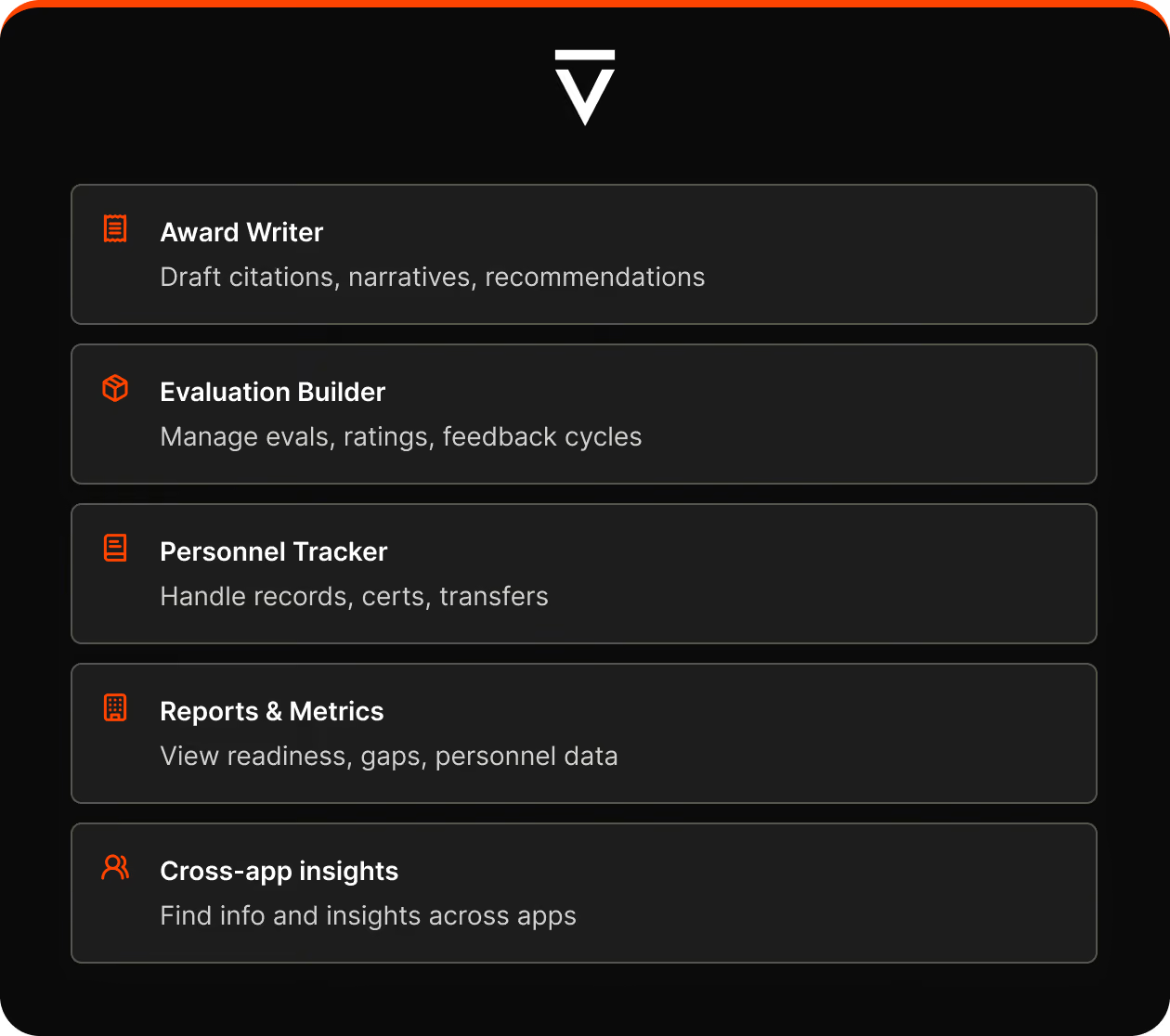
The Facilities Maintenance Pack arrives with the Apps, the CMMS connections, and the approval controls a facilities organization needs in its first weeks.
- Apps for the role: Built around a supervisor's dispatch decisions and a technician's next step.
- Full context: Apps read work order history, equipment manuals, job plans, storeroom inventory, technician qualifications, and schedules, and cite the manual or record behind a diagnostic or procedural recommendation.
- Carry out the work: Legion drafts the job package and reserves available parts, then proposes schedules, and writes back to the CMMS once a supervisor approves.
- Stay in command: Every action attributed and logged, including the ones an agent took.
No prompt engineering. No blank chat box. No months of integration.
Start With a Pack. Extend Without Starting Over.
Start with a Pack
Prebuilt Apps deploy in weeks, not months.
Extend within the Pack
Custom Apps built into your Pack, without starting over.
Systems connected today
CMMS
- Maximo
Documents
- SharePoint
- Box
Collaboration
- Microsoft Teams
Service and Business
- ServiceNow
- Jira
- NetSuite
What results has the Facilities Maintenance Pack delivered?
Results from federal and defense sustainment deployments
+25%
Technician capacity in the first weeks
20%
Less unwanted overtime
5+
Hours a week reclaimed per supervisor
1 minute
To generate a structured work order from an inspection report, against 20–30 minutes.
Is Legion authorized for the network you run?
- Same Pack, same governance in cloud, on-prem, and air-gapped deployments
- IL2 through IL6 for DoW networks, FedRAMP High for the cloud platform, ready to manage ITAR data
- Honors your existing access controls, with audit trails and full attribution including agent actions
- Your data stays in your environment. Models never train on it.

See the Facilities Maintenance Pack in your environment
- A walkthrough against your own work order and inspection data
- A deployment plan for your CMMS and your network
- Start at one site and extend across the facilities footprint
FAQs
What is the Facilities Maintenance Pack?
The Facilities Maintenance Pack is a role-based AI capability bundle for facilities and O&M teams. It turns urgent maintenance issues into job-ready response plans across the systems you already run, covering triage, likely cause and confirm steps, technician assignment, parts and tools, procedure, and safety requirements.
Does Legion replace our CMMS?
No. Maximo stays your system of record, and no data migration is required. Legion reads work order history, manuals, inventory, qualifications, and schedules, then writes structured work orders and schedule changes back once a supervisor approves them.
Our CMMS already schedules work. Why not extend it, or build this ourselves?
A CMMS is built to schedule work and hold records, and it does that well. Predictive platforms catch what sensors and service intervals can see. Legion is built for the repair order that arrives as a sentence in a work order note: reasoning across the manual, the repair history, the roster, and the storeroom to propose a response and show what it affects. An internal build has to reproduce those integrations, the approval controls, and the upkeep.
Our maintenance data is incomplete. Does this still work?
Yes, within a limit. Legion reasons from manufacturer manuals and job plans as well as your repair history, so it can propose a likely cause on an asset with thin local history. Incomplete repair history narrows the local evidence rather than stopping the proposal, and where it does not support a confident call, Legion says so.
Who approves the work Legion proposes?
A supervisor approves dispatches, schedule changes, work order releases, and reorder-point changes. Legion drafts the package, attaches the safety requirements found in your job plans and SOPs, reserves available parts, and readies the dispatch message. Every action is attributed and logged.
How does Legion handle safety-critical equipment?
Diagnostic and procedural recommendations cite the source and manual section behind them, so a technician verifies rather than trusts. Legion states whether confidence is high or low, and proposes confirm steps when the supporting evidence does not carry a confident call. LOTO, permit, and PPE requirements found in your job plans and SOPs come attached to the package.
What does a supervisor see about technician time?
The Pack does not use technician location. It proposes who should take a job from qualifications, availability, and current assignment, and it shows work orders running past their planned duration. What a supervisor sees is the state of the work.
What data and access does deployment need?
Work order history, asset records, technician qualifications and availability, manuals and job plans, and parts inventory, plus the security approvals to reach them. Legion reads these from the systems you already run. Dispatches, schedule changes, work order releases, and reorder-point changes all wait for a supervisor's approval.
Can the Pack run on a DoW network or in an air-gapped environment?
Yes. The same Apps and the same approval controls run in cloud, on-prem, and air-gapped environments. Legion operates across IL2 through IL6 for DoW networks, and the cloud platform carries FedRAMP High authorization.
How long does deployment take?
Weeks, not months. The Apps arrive prebuilt, so the work is connecting them to your CMMS and document repositories rather than building capability from scratch. The pacing items are usually security review, data access, and integration scope rather than the Pack itself.
What systems does the Pack connect to?
IBM Maximo, SharePoint, Microsoft Teams, ServiceNow, Box, NetSuite, and Jira are connected today. Additional CMMS and inventory integrations get built where demand is confirmed.