
Research Discovery and Analysis Pack
Turn a Stack of Papers Into a Cited Analysis
A performer's claim is up for review next week. Legion Intelligence finds the related papers, answers questions from each one, and drafts a cited comparison. Nothing is saved until a researcher checks it.


Legion software is proven by 20,000+ users across U.S. Special Operations Command, and deployed on-prem at a U.S. Department of Energy national laboratory.
What does the Research Discovery and Analysis Pack do?
Built for scientists and researchers doing focused literature review, program and technical leads who assess research performers, and the peer reviewers who pick the work up later.

Find the papers worth reading
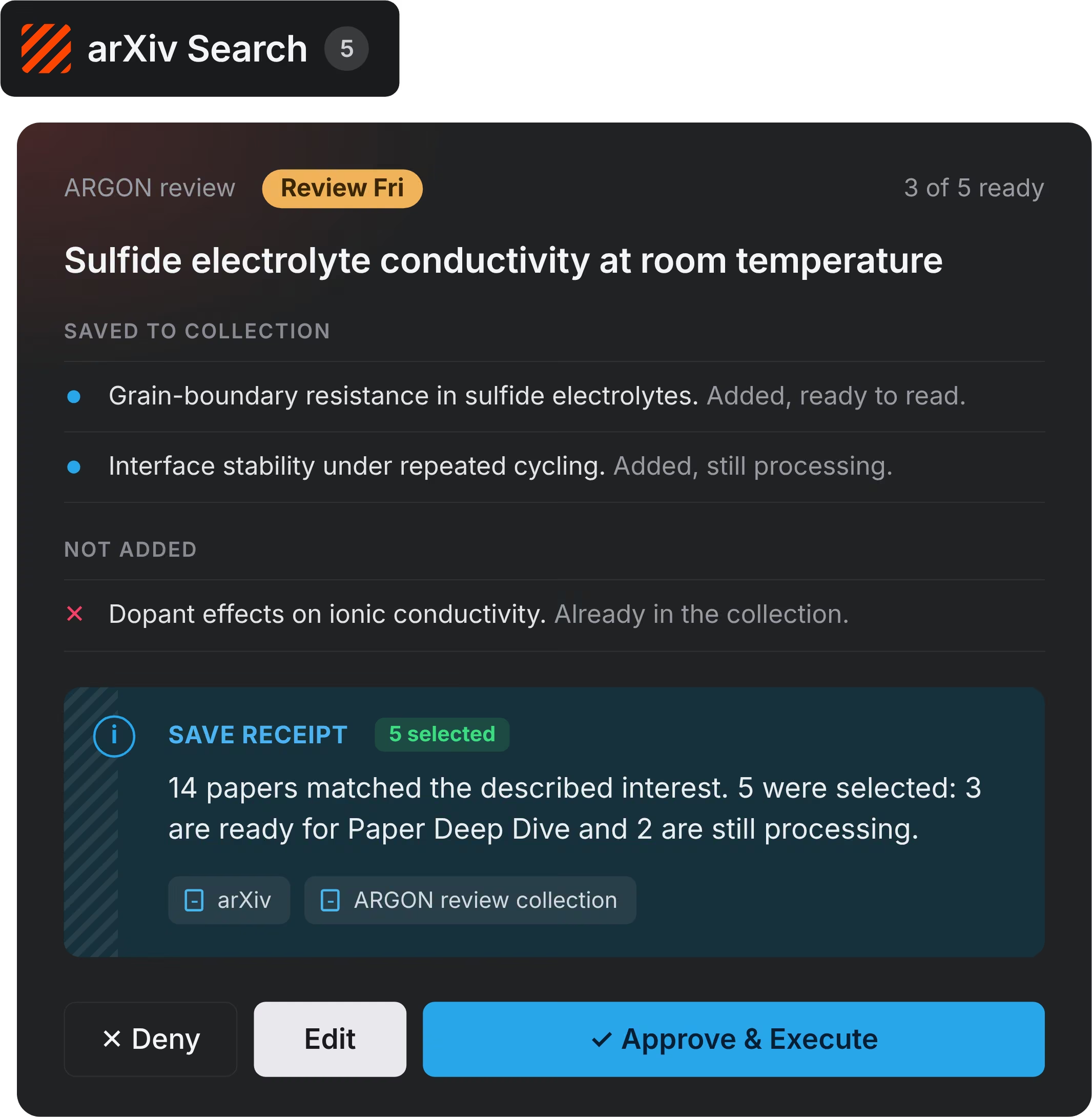
Describe the question and save the papers you pick in one step.
- arXiv Search takes a described research interest and returns matching papers with their abstracts
- Pick the papers to keep and save up to five PDFs at a time to a new or existing collection
- A receipt shows what was added, what was already there, and what is still processing
Get to what each paper shows
Ask the paper itself, and keep each note tied to its passage.
- Paper Deep Dive answers questions from that paper only, and the conversation stays with it
- Suggested annotations carry the quotation and location behind each one
- It says what the suggestions don't cover, and nothing is kept until you edit and save it
Compare the evidence and write it up
Build a cited comparison and keep the project ready to reopen.
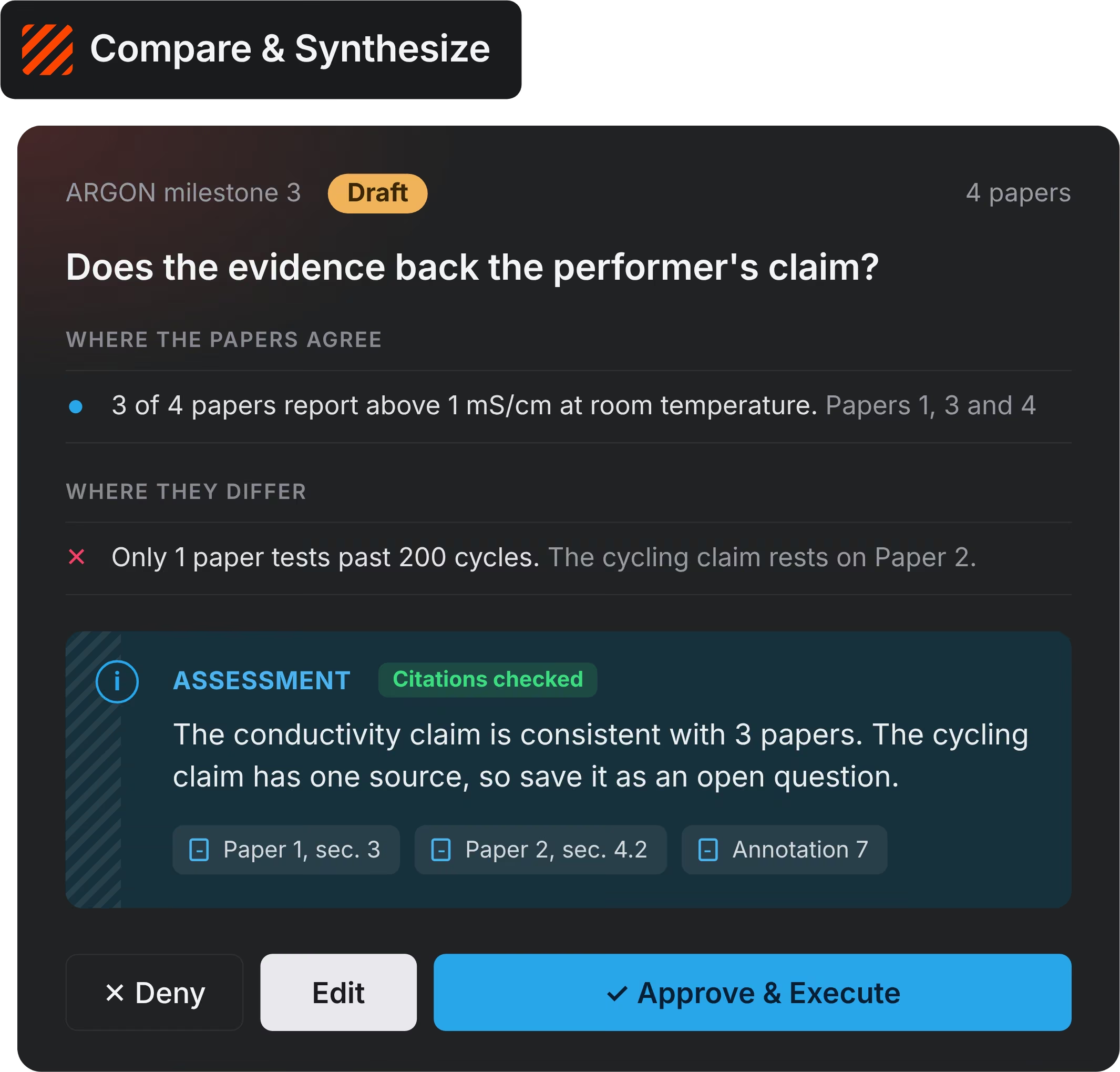
- Compare & Synthesize drafts a cited analysis from selected papers and saved annotations
- Each citation is checked against the original evidence and source version before you edit
- Project Notes keeps goals, hypotheses, and saved analyses, and its Writing Helper suggests wording
Agents do the work. You stay in charge.
Nothing becomes part of the record until a researcher saves it.
Works with the systems you already use
Preprints
- arXiv papers
Uploaded documents
- PDFs
- Technical reports
Collections
- Legion Collections
Performer work
- Performer reports
- Milestone reports
Deployment and security
- Same Pack, same governance in cloud, on-prem, and air-gapped deployments
- IL2 through IL6 for DoW networks, FedRAMP High for the cloud platform, ready to manage ITAR data
- Honors your existing access controls, with audit trails and full attribution including agent actions
- Your research stays in your environment. Models never train on it.

See the Research Discovery and Analysis Pack in your environment
- A working session on one of your own research questions or performer reports
- A cited comparison with its sources attached
- A pilot scoped to one research team or program, measured on one number

FAQs
What is the Research Discovery and Analysis Pack?
The Research Discovery and Analysis Pack is a set of Legion apps for focused literature review. A researcher finds and saves arXiv papers, asks questions about each one, keeps annotations tied to their passages, and builds a cited comparison, all in one project they can reopen.
What problem does it solve?
A literature review usually means searching arXiv, downloading PDFs one at a time, reading each paper end to end, keeping notes in a separate file, and writing the comparison from scratch. The Pack keeps that work in one place, with every note and comparison tied to the passage it came from.
Who is it for?
Scientists and researchers use it for focused literature review, on a scientific question or a research performer's report. Program and technical leads use it to assess what performers claim, and peer reviewers use it to see the evidence behind a conclusion without rebuilding the work.
Does it replace arXiv or our literature search tools?
No. Keep searching where you already search. The Pack brings the papers you pick into a collection, carries them into reading, annotation, and comparison, and keeps track of what you've already read, noted, and compared.
Who approves what Legion recommends?
The researcher does. Searching doesn't save papers, suggested annotations aren't kept until the researcher edits and saves them, and a comparison has to be saved to a project to keep it. Legion finds, suggests, and compares, and the researcher decides what the evidence means.
What happens when Legion doesn't have enough information?
Paper Deep Dive answers from the paper in front of it, and its suggested annotations say what they do and don't cover. Compare & Synthesize checks each citation against the original evidence before the researcher edits the result. Reading figures and tables alongside the text is on the roadmap.
How is this different from a research chatbot?
A chat tool answers one question at a time and doesn't keep the evidence. The Pack keeps each answer with its paper, the quotation behind every annotation, and the citations in every comparison, so a reviewer can check each point against its source.
Which systems does it connect to today?
It searches arXiv through arXiv Search and works from documents a researcher uploads or groups in a Legion Collection. Other research sources aren't connected yet.
Where does it run?
The same Pack, with the same governance, runs in cloud, on-prem, and air-gapped deployments. Sensitive or export-controlled research stays in your environment, collection access is respected in every search and answer, and models never train on your data. Project records are visible across your organization, so teammates can follow the reasoning.
What results has Legion seen on similar work?
On grounded research workflows at a U.S. Department of Energy national laboratory, what took ~2 hours in standard AI chat drops to ~10 minutes, 12x faster to verify research. The same work showed 6 hours saved per research activity and 80% less follow-on research, including time previously spent validating outputs.
How do we start?
Bring one research question and one long report to a working session. Legion finds the related papers, answers questions from the report, and drafts a cited comparison you can check. From there, teams add more topics and investigations.