
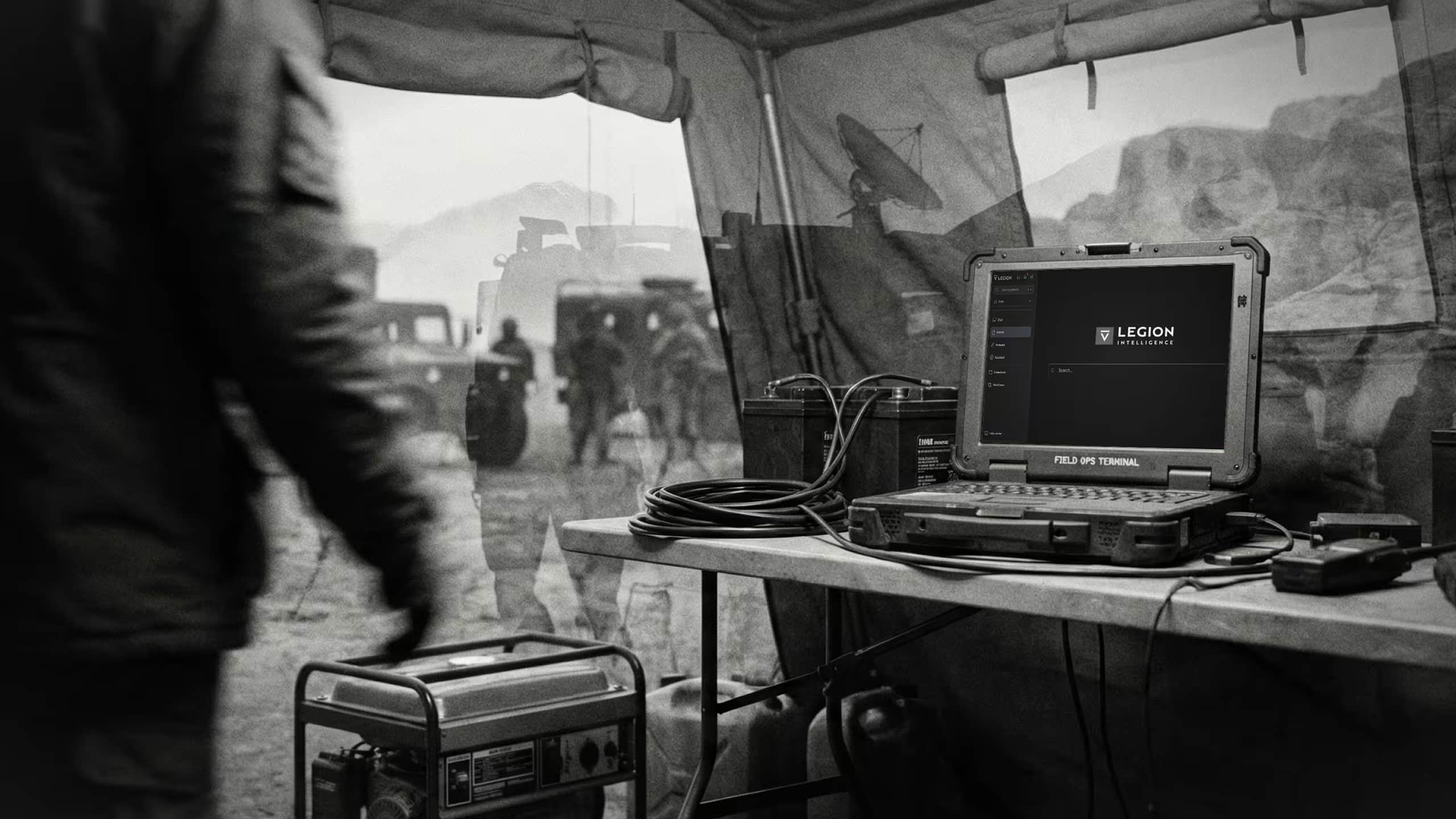


A forward intelligence cell has an intelligence summary due within the hour. The network is congested and dropping, reach-back to the cloud keeps failing, and the AI that worked fine in garrison has gone dark. The work cannot wait for the link to return. That situation has a name.
What is DDIL?
DDIL stands for Denied, Degraded, Intermittent, and Limited. These are the connectivity conditions of contested environments, where links may be unavailable, unreliable, or risky to use. The term originates in military communications doctrine; the “L” is sometimes read as “low-bandwidth.” Both describe the same operating reality:
- Denied: connectivity is actively prevented or cut, by jamming, network attack, or blackout.
- Degraded: links work, but performance drops due to low bandwidth, high latency, or packet loss.
- Intermittent: connectivity comes and goes unpredictably.
- Limited: connectivity is constrained in capacity, range, or duration. It’s usable but restricted.
These are the conditions of the tactical edge, where AI has to keep working over contested, unreliable links, not the stable ones a demo runs on. Performing in DDIL is now the bar: the Department of War's AI-first strategy judges agentic systems by how fast they deploy and how much they cut cycle time in real operations, not by how they look in a permissive demo.
In a contested environment, a system cannot meet that standard unless it keeps working through DDIL. If AI cannot work in DDIL conditions, it fails exactly when the mission depends on it.
Why does cloud-dependent AI fail in disconnected or low-bandwidth environments?
Cloud-dependent AI fails in disconnected or low-bandwidth environments because the connection it relies on is among the first things an adversary targets. Peer adversaries contest connectivity through jamming, cyber operations, strikes on infrastructure, emissions tracking, and deception. Cloud-hosted AI runs in a remote data center and answers each request over that link. When that link is contested or cut, the request cannot complete and the workflow stops. An architecture that assumes constant cloud access shifts that risk onto the warfighter. It works in permissive conditions and fails when bandwidth is constrained, links are denied, or transmitting becomes dangerous. Any warfighter who has relied on a cloud common operating picture (COP) knows it can work in the HQ exercise and still fail at the operational edge.
Thankfully, the Department of War often simulates DDIL environments in exercises, as we saw during Scarlet Dragon 26-01. We have seen an uptick in “edge” capabilities falling short in these scenarios because most software providers do not solve for the limitations of true operating environments.A forward-deployed headquarters operates under constant threat to its networks, and an AI system that needs the cloud risks going dark at the moment of greatest demand. Intermittent latency alone disrupts staff battle rhythm and erodes trust.
What does AI need to operate in a DDIL environment?
AI built for a DDIL environment runs locally, enforces governance offline, and keeps a human in command. Six requirements separate a real DDIL capability from a cloud tool with an offline mode:
- Local operation on the node. Models, agents, and workflows run on the forward-deployed system without depending on reach-back.
- Governance and audit that persist offline. Access control, approvals, and audit logging stay on when the cloud is gone, which is an architectural decision, not a network-dependent feature.
- Deterministic, user-scoped ingestion. Operators define which sources the system uses, so outputs stay anchored to authoritative reporting.
- Human decision authority. The system speeds up synthesis and drafting; a person validates and decides.
- Automatic model failover. Connected, it uses the latest customer-approved frontier models; when the link degrades or drops, it shifts to locally hosted open-weight models automatically. Disconnected nodes still take controlled model updates with validation and rollback, so the edge does not freeze at an outdated model.
- Mesh coordination. Nodes share work when links allow and synchronize when connectivity and policy permit, never as a condition of operating.
Built this way, the essentials keep working without reach-back: document exploitation, intelligence summarization, planning, local retrieval, geospatial context, collaboration, and audit logging all continue offline.
How did Centurion perform in a DDIL field evaluation?
The requirements above are demanding, and the real test is whether a system holds them when the network is actually gone. Centurion by Legion Intelligence is an integrated hardware and software AI system at the tactical edge, and at Scarlet Dragon 26-01 it ran disconnected under live conditions. The exercise, run in December 2025 by the XVIII Airborne Corps, is the Army and Joint Force’s premier venue for CJADC2, Next Generation Command and Control, and AI experimentation. Because the models, governance, audit, and hardware ship and sustain as one system, a unit does not have to assemble and operate those parts itself. That same single-system model, with its documented bill of materials, is also what can shorten the path to an authority to operate. See how to field accredited AI at the edge for the accreditation and procurement detail.
The XVIII Airborne Corps G2 evaluated Centurion Large (L), a rack-scale HPE Gen12 DL380 with two NVIDIA H200 GPUs, on the Corps' tactical SIPR at IL6, fully disconnected with no cloud reach-back.
Centurion installed in one day, with most users proficient within an hour, and the customer-specific agent workflow was built and refined on site in under five hours. INTSUM drafting fell from about four hours to about five minutes for a structured draft, 48x faster. Target system analysis dropped from about 30 minutes to about two minutes per system, 15x faster, at roughly 85% accuracy before refinement. During Intelligence Preparation of the Operational Environment, Centurion organized thousands of pages of higher-headquarters orders into usable structure in minutes. An Army all-source analyst put it: "I can spend my time doing critical thinking and analysis, rather than finding information and formatting a document."
At USSOCOM TE 26-02, Centurion X ran AI for mission planning in disconnected environments, supporting Military Decision Making Process workflows on government data and switching to locally hosted models, with no operator intervention, when the network dropped. That deployment ran on HPE’s EL8000S edge hardware with Rancher Government Solutions' hardened platform.
Across both exercises, Centurion ran disconnected with local operation, offline governance, and the automatic failover TE 26-02 triggered; mesh coordination is built into the architecture. Scarlet Dragon used the rack-scale Centurion L and TE 26-02 used Centurion X; the same Legion software and Packs run on smaller, more mobile form factors as well, and Centurion applies the same governance whether online or dark.
When is an edge AI system not the right fit?
An edge AI system is the wrong tool when connectivity is stable and the workflow does not need to survive a dropped link. Cloud-hosted AI has earned its place in garrison, enterprise analytics, and experimentation, where bandwidth is reliable and a dropped connection costs a page refresh rather than a stalled decision. A single user drafting on one laptop does not need an organizational edge system either.
What an edge AI system adds is organizational scope: it coordinates governed agent workflows across many users and mission systems, scales to hundreds of operators, and moves between local and cloud models as conditions allow. The deciding variable is the mission profile: whether the work has to survive a dropped link. If the work has to continue when the network does not, an edge system earns its weight; otherwise, a cloud tool is the simpler choice.
Test it without a network
A DDIL capability is only worth fielding if it keeps running when the connection drops. If your work has to survive denied, degraded, intermittent, or limited connectivity, request a Centurion field evaluation to see governed agent workflows run disconnected on your own data. For the full evaluation results, read the Scarlet Dragon 26-01 case study and the Command Paper on agentic AI at the tactical edge. For the full deployment detail, see the Centurion edge-deployment whitepaper.